Aggregate planning
Aggregate planning is an operationalactivity which does an aggregate plan for the production process, in advance of 2 to 18 months, to give an idea to management as to what quantity of materials and other resources are to be procured and when, so that the total cost of operations of the organisation is kept to the minimum, over that period.
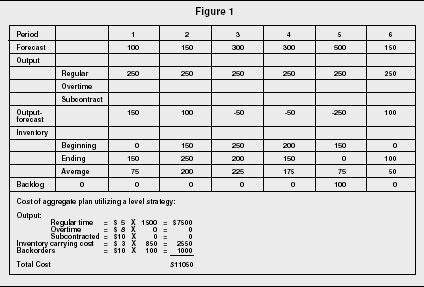
The quantity of outsourcing, subcontracting of items, overtime of labour, numbers to be hired and fired in each period and the amount of inventory to be held in stock and to be backlogged for each period are decided. All of these activities are done within the framework of the company ethics, policies, and long term commitment to the society, community and the country of operation.
Aggregate planning has certain prerequired inputs which are inevitable. They include:
- Information about the resources and the facilities available.
- Demand forecast for the period for which the planning has to be done.
- Cost of various alternatives and resources. This includes cost of holding inventory, ordering cost, cost of production through various production alternatives like subcontracting, backordering and overtime.
- Organisational policies regarding the usage of above alternatives.
Options for situations in which demand needs to be increased in order to match capacity include:
Pricing. Varying pricing to increase demand in periods when demand is less than peak. For example, matinee prices for movie theaters, off-season rates for hotels, weekend rates for telephone service, and pricing for items that experience seasonal demand.
Promotion. Advertising, direct marketing, and other forms of promotion are used to shift demand.
Back ordering. By postponing delivery on current orders demand is shifted to period when capacity is not fully utilized. This is really just a form of smoothing demand. Service industries are able to smooth demand by taking reservations or by making appointments in an attempt to avoid walk-in customers. Some refer to this as "partitioning" demand.
New demand creation. A new, but complementary demand is created for a product or service. When restaurant customers have to wait, they are frequently diverted into a complementary (but not complimentary) service, the bar. Other examples include the addition of video arcades within movie theaters, and the expansion of services at convenience stores.
Options which can be used to increase or decrease capacity to match current demand include:
Hire/lay off. By hiring additional workers as needed or by laying off workers not currently required to meet demand, firms can maintain a balance between capacity and demand.
Overtime. By asking or requiring workers to work extra hours a day or an extra day per week, firms can create a temporary increase in capacity without the added expense of hiring additional workers.
Part-time or casual labor. By utilizing temporary workers or casual labor (workers who are considered permanent but only work when needed, on an on-call basis, and typically without the benefits given to full-time workers).
Inventory. Finished-goods inventory can be built up in periods of slack demand and then used to fill demand during periods of high demand. In this way no new workers have to be hired, no temporary or casual labor is needed, and no overtime is incurred.
Subcontracting. Frequently firms choose to allow another manufacturer or service provider to provide the product or service to the subcontracting firm's customers. By subcontracting work to an alternative source, additional capacity is temporarily obtained.
Cross-training. Cross-trained employees may be able to perform tasks in several operations, creating some flexibility when scheduling capacity.
Other methods. While varying workforce size and utilization, inventory buildup/backlogging, and subcontracting are well-known alternatives, there are other, more novel ways that find use in industry. Among these options are sharing employees with counter-cyclical companies and attempting to find interesting and meaningful projects for employees to do during slack times.
posted by superpogi @ 7:26 AM
1 comments